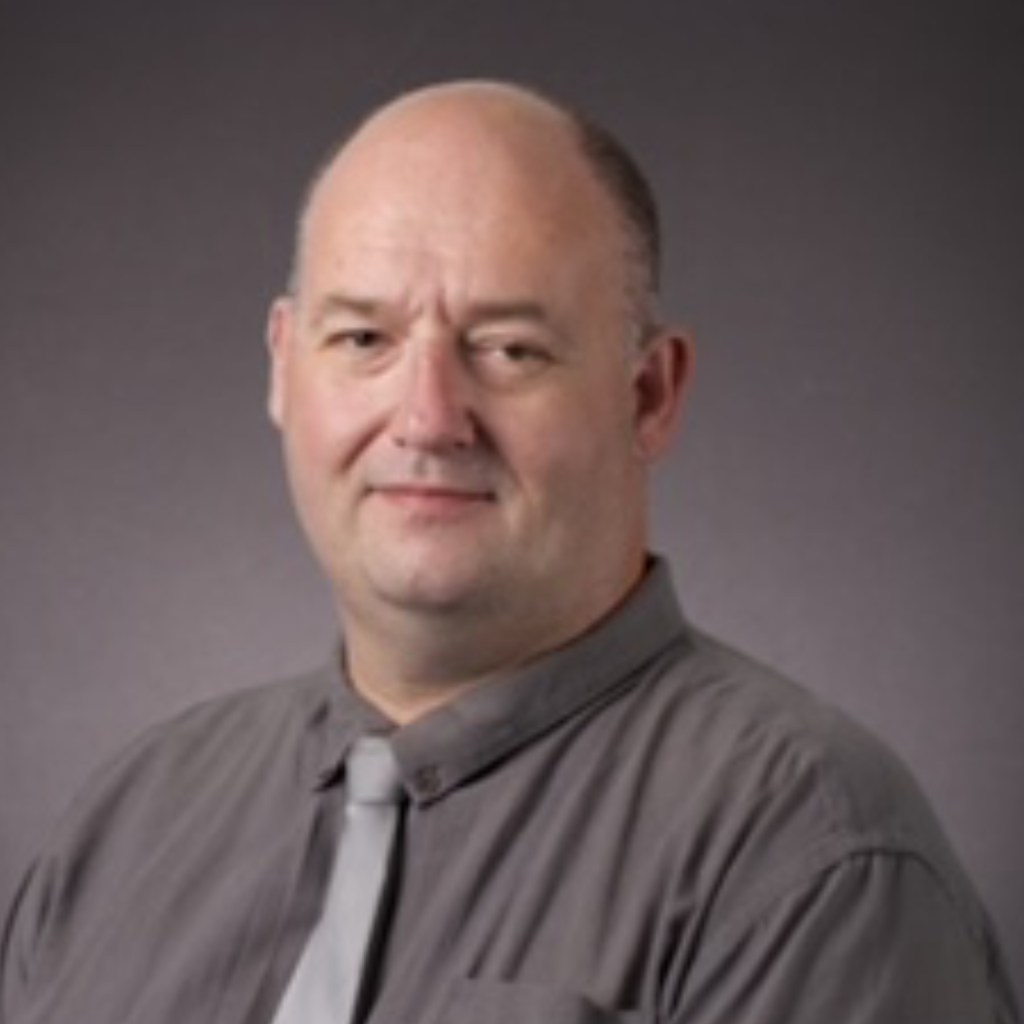
Ian Morris
Written by Jamie Davies
Portsmouth local Ian Morris, also known as “Tiny”, approaches life and the difficulties of vision impairment with a can-do attitude. It’s a trait which has seen him working top roles at companies like Pfizer and, most recently, the sight loss charity Guide Dogs UK. He’s always busy, spending his time travelling, playing cricket for local team Sussex Sharks and co-hosting the Pompey Politics podcast along with his brother-in-law Simon Sansbury.
Ian lives with retinitis pigmentosa (RP), the name given to a collection of hereditary disorders which cause deterioration in eyesight and eventually total sight loss. RP prevents the rods and cones at the back of the eye from regenerating, leading to a deterioration pattern that slowly spirals inwards. Ian lives with an advanced stage of RP. He explains, “I only have my dark perception, so I can see that there’s the sky and not the sky, but being able to differentiate different objects is impossible.”
The first real sign of vision issues for Ian came in his early 20s, when he failed to spot a milk float while driving and almost crashed into it. Tests on both himself and his brother revealed that they were both showing early signs of RP; Ian discovered he had lost virtually all of his peripheral vision. “It made some pieces fall into place”, he says. “I used to play a lot of sport…if you [were to] hit the ball straight back at me, I follow it, I belt it back at you twice as hard. But if it came off the edge of the racket or if somebody put a lob up, it’d just go out of peripheral vision and I’d just be stood there going ‘where’s the ball gone?’”.
He was able to measure the extent of his sight loss by the intensity of the magnification needed to read text: first 12-point, then 14, to 20 and finally 32. After that, no level of magnification was enough; Ian would have to work his ears overtime with an array of audio assistance technologies. “I work now in an all-audible world”, he says, highlighting the raft of smart devices deployed around his home for living, working and relaxing.
Smart devices have made living with a vision impairment much easier, but it wasn’t so easy in the 90s when Ian was starting his career. He recalls with dread the audiobooks which required lugging around 12 cassettes, and the singular early mobile phone which could be upgraded with audio assistance features (for an additional sum of £130). Luckily, he found an employer who saw potential beyond his impairment, a fact that Ian remains grateful for: “you do sometimes have to have a lucky break to find those employers who are open-minded enough to say ‘I’m going to look beyond what I see as a disability and actually look at the person’”. Not that Ian has been totally spared from exclusion in the workplace. He looks back on instances where employers overlooked him because his lack of sight was seen as too much of a barrier: “they can’t work out how they would do the job if they were blind”.
Contrary to what those employers think, Ian believes that being blind has actually made him a better employee as well as an outstanding problem solver, particularly in his senior position: “If you’re trying to convey a message or an idea, it’s very easy for you to do a very sexy looking powerpoint, throw it up on the screen and dance around it…but actually if you want to sell the idea to me you’ve got to explain it, you’ve got to tell me what it is you’re showing me. And whilst you might see it as an inconvenience, I see it as a strength”.
Part of that strength, for Ian, comes with embracing help when it’s needed: “if you’re clear about what you’re asking for, I’ve found that most places are really eager to help”. He doesn’t let the fact that he sometimes needs assistance define him though; he’s not a blind person but a person who happens to be blind. That’s an attitude he maintains in all aspects of life, from sport to work and beyond.
Despite the challenges that still exist for him, Ian feels there has never been a better time to be blind. Between the various assistive technologies available, growing levels of social inclusion and the increasing numbers of workplace opportunities, he believes that nobody with a vision impairment needs to feel like they can’t pursue their goals.
And his advice for a young person struggling with sight loss? Recognise that you have skills, that you’re valuable even though there will be days where you’re feeling down: “disimpaired people come in all shapes and sizes, and attitudes and aptitudes, and it’s [about] looking beyond that label to see ‘what is it that defines me?’”.

Blindsided
At 19, the world is yours. But sight loss doesn’t care about your age, and it can bring your life to a standstill. Based on a true story.
 14 Stories